Friday, October 19, 2012

The Market

Greetings once again all you lovely shoe freaks and bespoke junkies from around the world. I am back! Refreshed and energised from a week's holiday in Cyprus. Now, I don't want to make you jealous but we had a week of sun and 30 degree heat - just what the doctor ordered.

Here is a selection of how a happy shoemaker enjoys his happy hols.


I don't know what it was but every cat on the island ( and there were many) seemed to want to fall asleep in my lap. Cute!


Fishy foot spa. This was weird but quite pleasurable. I don't know if it made any difference to my feet though.


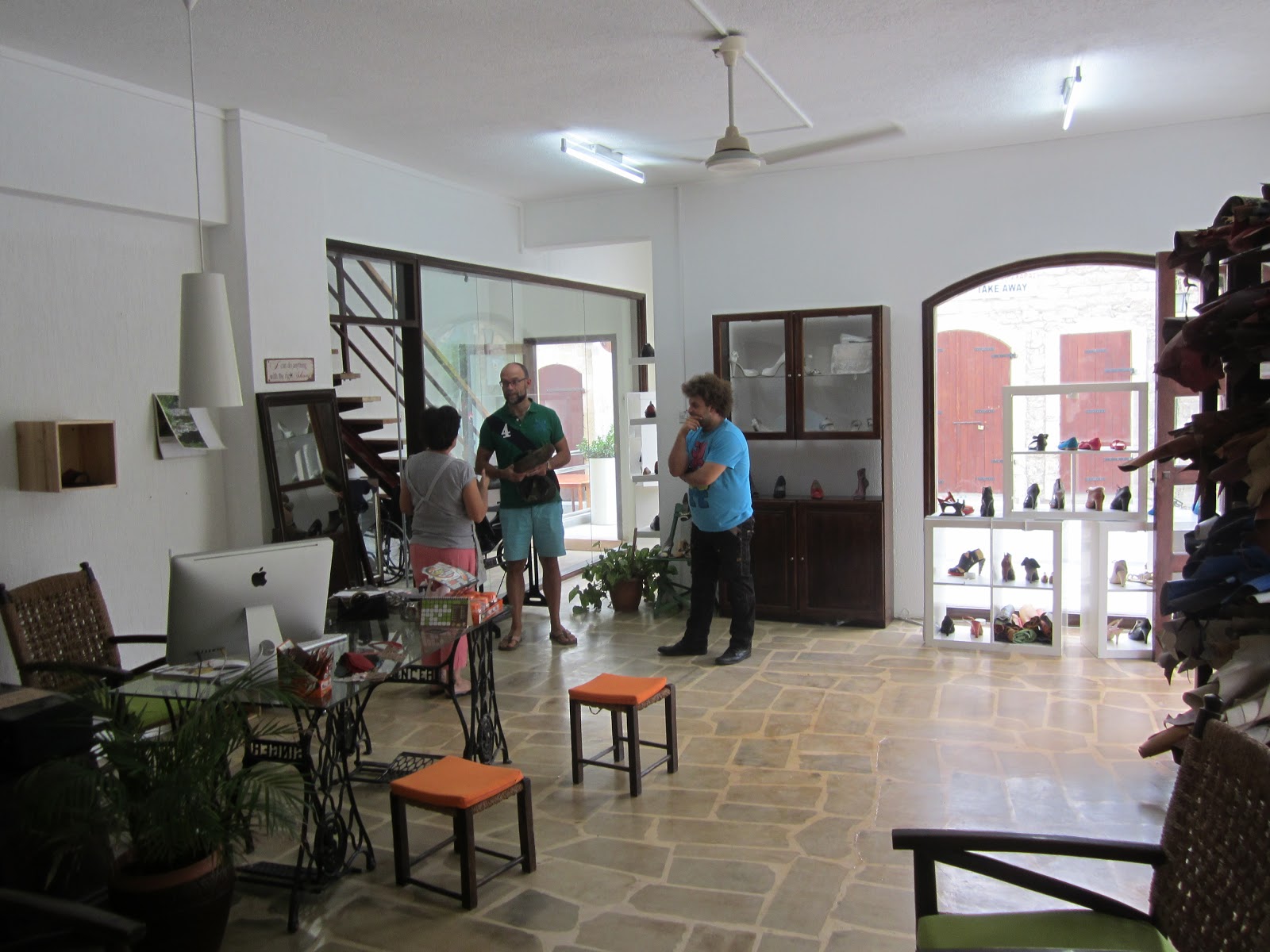
Now, while we were walking round the old town of Limassol, we found this shop which sells made to measure shoes. Delighted and intrigued we went in.
 

The interior was as lovely as the shop front.


I got talking to the owners and it turns out to be 3 generations of shoemakers working on 3 floors - the shop, a workshop above and office space above that. We chatted about shoes and shoemaking; methods; leathers etc. It turns out that they make mostly glued shoes and fit up existing lasts from their archive for each customer. They make the patterns, click and close the uppers and make the shoes all on site - fantastic

The younger son had even been to de Montford University in Leicester to study footwear and had studied under our old friend Bill Bird.

They showed us their workshop which I was very glad to see was the typical controlled chaos of the shoemaker's atelier. I felt totally at home.


So this all seemed wonderful - until we started talking prices. They told me that they charge 180 Euro for a pair of shoes. I was shocked. I felt bad for them, felt that their skill and knowledge was undervalued. I know what it takes to make a pair of shoes - from taking the measures and making them fit to sourcing the leather and making the uppers. I asked them how they made a living and they said it was hard, that they did repairs too, a constant struggle (that, at least I understood).
They told me that people come in with shoes to copy and then decide to buy the Prada shoes up the way for 700 Euro instead. Gutting!

But afterwards I got to thinking. If you are making shoes, you have to charge according to the market you are in. On a relatively small island, this is what the market can stand. People will simply not pay more and that is the reality of the situation. We are very lucky here in London. We can target a wealthy demographic with the money and inclination to buy our shoes at a price which reflects their quality. Prices (and quality) vary widely around the world and if you just think about artisan shoemakers like us or Lydias, we have to make shoes which our customers both want and can afford.

There was some criticism recently on an internet forum of a company which makes shoes in a small factory, using local products where possible for a local market. The shoes are glued, then stitched and shaped when wet so that no lasts are necessary. In my opinion they are hideous but perfectly wearable. The criticism seemed to be that they give the world of shoemaking a bad name and threaten all of us who propose to make artisan hand crafted shoes because they promote themselves as artisan made shoemakers (BTW they don't really promote themselves in this way)

This is a tricky one. People make shoes all round the world for very different client bases and for very different prices. But one thing they have in common is that people wear them and pay for them and part of what we shoemakers do must be driven by our customers.

At the end of the day, I applaud anyone who can make a living at making shoes in a more or less handmade way. Given the price competition from mass produced junk shoes, it is a pretty amazing feat.

But it also goes to show that people only go into shoemaking because they love it and have a passion to make shoes, despite it being a constant struggle. It's one of the things I like about shoemakers I have met - we are passionate

Long live shoemaking!

Until next week, happy shoemaking!

Friday, October 12, 2012

Making a matching pair

Occasionally not everything goes right in the world of the shoemaker...we had an incident recently where we had finished a pair of low ankle boots for riding. They were looking lovely, but somewhere between them being finished and the trees being made one of the boots was damaged. It was just a few days before the client was due to collect them and we felt terrible having to disappoint her after her patience attending fittings and then waiting for the finished footwear.

We always believe that honesty is the best policy and emailed the client immediately. She did ask about putting a patch on the damage when she saw it, but we really take pride in our work and just couldn't let something leave our workshop that wasn't 100% excellent.

So we knew we had a remake on our hands. Remaking just one boot or shoe is quite difficult because it is imperative that it looks a pair with its partner when finished.

The first stage was to carefully remove the heel and to then cut the sole stitches so that it could be removed - along with the cork and shank - without damaging the insole too much. We then cut off the upper, soaked it and carefully removed the stiffener and toe puff. The patterns were sent off for a new upper to be made immediately and meanwhile we blocked a new insole.

Once the insole had dried we trimmed it as usual. To help to get this new boot as similar to the original as possible we used the original insole as a template. We copied across the heel marks, the holdfast markings and shaped the waist in the same way as before.

Fortunately the upper was turned around in super-quick time and, using the original stiffener and toe puff, we lasted it over to let the leather take the shape of the last making sure that the caps were straight and the same length. We also had to make sure the back height was the same and that the facings matched.


The boot was then welted and the welt trimmed to shape using the good boot as a model for the amount of welt showing and the position of the row of stitches.

Fitting the shank, cork and sole was plain sailing (again making sure the sole thickness was the same, in this case, 1/4"). The next step was getting the heels to match. Again we used the good boot as a guide for heel height and overall shape.


Then we sanded back the original boot heel and edges and refinished both boots together to ensure an exact match. And hey presto! A pair of boots.


 We are really looking forward to sending them off to the client next week...and we hope that the horses don't step on them too soon!

Until next week happy shoemaking!

Friday, October 5, 2012

The Colourists

It's a case of while the cats away the mice will play - with Mr Ducker off topping up his tan in sunny climes - I'm hard at it, at the proverbial shoemaking coal face!

It's been a great week ...lots of making, designing, successful first fittings (I love it when the fit is good first time) and confirming stage two of a very creative design project we are involved with!


We are making shoes for a series of advertisements for Tim Page Carpets in Chelsea Harbour for super glossy home interiors magazine, World of Interiors. It is great fun and a creative challenge making shoes from their luxurious, colourful and patterned interiors fabrics, braiding and wallpaper. Here are the first two which are out now - and yes, the boots are handsewn! My personal favourite is the next one to appear...a ladies ribbon-ties platform! If you can, pop down to Tim Page to see the shoes that we have made so far.


Which leads me nicely onto the subject of colour. Men are being much more adventurous with their choice of shoe colours. You'll no doubt have seen more colour coming through in the men's fashion magazines and on the high street - lead by the indubitable Mr Hare who opened his new shop recently in Mayfair.


Our clients are starting to show their true colours too. Take the Battenberg's, for instance? They are well ahead of the fashion curve and, although they may not be to everyone's taste, they really show where we excel in bringing our customer's dream shoes to life.


Just imagine them on a sunny day, with a cream wool jacket and flannels or corduroys. I am certain that they will certainly hold their own in the fashion stakes in San Francisco and get a lot of attention. Our client is wearing them for the first time this week thanks to an 'Indian summer' so I'm looking forward to being sent pictures showing the chosen outfit in all its glory. He'll be the talk of the San Francisco men's style pages (and staying away from red wine)!

He will also be thrilled to hear that he has indeed started an all-pink trend! We had a fitting this week with an elegant black wholecut with a gorgeous pink kid lining. It is also this gentleman's first foray into bespoke shoes - who said guys were scared of colour? And there's more colour to come with brown derby's with citric lime accents and a permanganate lining; brown shrunken calf button boots with permanganate; and grey suede slip-ons coming through.

We've dubbed our bolder tasted customers 'the colourists'  and we're looking forward to seeing many more of them in the future.

Mr Ducker will be back with more things shoemaking next week. Until then happy shoemaking!

Friday, September 28, 2012

A Bespoke Fit


It’s been a busy week at the studio with the Added Value? exhibition, a talk by iconic fashion commentator Colin McDowell, lots of fittings, new lasts being delivered and eagerly-awaited shoes being despatched to overseas customers…the pink and cream Battenbergs are on their way! (Boy, have I had sleepless nights about them, nightmares about things being spilt on them, water seeping under their covers etc.). But they left us spotless and now we hope that they do the trick – make a certain customer very, very happy and give his colleagues something to talk about!!  

Anyway, the fittings are always an exciting time because it is when we see how well our measurements have been interpreted by the last makers and it is when the customer gets a first look at their uppers. So whilst they are admiring the successful interpretation (we hope) of their dream shoe we are concentrating on the fit – are there areas that could fit better, how do they feel and is extra comfort or support needed?

Blogs and shoe forums usually talk about bespoke shoes in terms of style, but the comfort and fit is as important if not more important than the look. This is particularly true of customers who live with painful foot problems...as it’s our job to try to help to reduce or alleviate their discomfort where we can. The most common complaints we see are:

Hammer toes – where the toe is curled at the first joint raising it above the horizontal plane of the foot. This is usually caused by shoes that are too tight at the front or heels that are too high.

Morton’s Neuroma – where the nerves between the toes are inflamed (as the wearer of far too high and too tight shoes in my youth I know all too well about this myself and have had cortisone injections to try to manage the pain) and cause pain and numbness. Bespoke shoes are very effective in helping to relieve the pain by reducing the pressure on the metatarsals.

Bunions – caused predominantly by not wearing good fitting shoes, arthritis and inherited structural defects. It is an unsightly, painful bony mass that forms on the big toe joint and points outwards forcing the other toes to crowd against each other. Again, we can create space for the bunion and compressed toes within a bespoke shoe to help to alleviate the symptoms.

Flat feet – where the arch inside the foot is flat. This is very common and usually not problematic although it can cause the foot to pronate (rotate inwards). Orthotics or a bespoke insole-up-in-waist can help to correct the pronation.

Plantar fasciitis – this is a very common cause of heel pain where inflammation at the bottom of the heel bone causes excruciating pain.  It is treated with a combination of pain control, steroid injections, proper foot wear and rest. Its nickname is “policeman’s heel” and cushioning built into the shoe can help as part of an overall pain management plan.

All in all, helping to alleviate the above problems is perhaps one of the most rewarding parts of our bespoke work. Not only do we deliver a pair of shoes to suit the customer’s personal taste and style but we help them to feel more comfortable and confident by helping to reduce or alleviate some of their symptoms. One of our customers literally claimed that we had transformed his life! It doesn’t get better than that for us!

For now, we’re looking forward to our evening course starting on Monday and completing more customer shoes next week. Until then happy shoemaking!

Friday, September 21, 2012

Added Value?

Welcome back, shoe people, we hope you have had a great week. We certainly have - Wednesday saw the launch of an exhibition by the Crafts Council called Added Value? which explores what commissioning bespoke work gives you beyond the monetary value of the product. Things like experience; knowledge of materials; a personal relationship with the maker; input into the product; supporting the local economy; exclusivity etc.

They chose six bespoke companies producing very different products, including carreducker.

The following Link will take you to some short films about each company. Luckily ours is first and we are really proud of it - hope you like it.

The exhibition was part of designjunction which, in turn was part of London Design Week. It is on at The Sorting Office, 21-23 New Oxford St which is an old Post Office building in the heart of London and has a lot of the old sorting machinery in place where the letters and parcels were shunted around. It's a massive space, spread over three floors and just right for a show like designjunction.


The afternoon was the Press View and we met various journalists and curators from around the world. There is talk of the show going to Hong Kong and Dubai - hello! And then there was a private view in the evening. Numbers were huge and there were queues down the block to get in. So a lot of people saw us which is fantastic.


Love the old chutes which go from floor to floor. Do you think the workers were ever tempted to go down one?


Here is the Added Value? exhibition. Each company had a stand with one piece of work on display and then another stand with a video, images and description. We thought it was very well presented and reflected the quality of the work on show .


Our Shoes


We really liked the brass lettering for the company name.


Another feature was customer recommendations which really gave a sense of what bespoke adds to the customer experience.


Entry to the show is free, but you need to register on the following link to get in.

If you are in London over the weekend it is a really interesting visit.

And that is our news for the week. Until next Friday, happy shoemaking!

Friday, September 14, 2012

A New Kind Of Last

Hello, one and all, and welcome back to the carréducker blog. Another week, another shoe, I suppose you could say.

Added Value? starts next week, so if any of you are in London and would like to go, it's free, but you need to register here

Below is a typical last with a cone, the old fashioned style of last if you like. Very functional, but quite hard to pull (with a hook) and if you need to get the last back into the shoe for any reason, it can prove difficult. The good thing about them is that if you do need to block a finished shoe, the forepart and heel are connected, so that when you hammer the heel area, it really pushes right up to the toe.


Next you have the sprung last with a sprung hinge in the waist. This is much easier to pull - you just break the last on a pin and then pull it out. It is also much easier to get back into a shoe if you need to make an adjustment.


And here is a third type of last which is new to us.


We have recently started working with a new last making company called Crispinians. With over 20 years experience in bespoke last making and a similar period of time in tree making, we thought we would give them a chance. The advantage of working with them for us is that they are in London and we can discuss face to face any issues that arrive from measuring to fitting.
They have recently set up business and will make bespoke lasts and trees and also runs of lasts - check them out. They are very friendly and helpful.


This is called the easy exit last, where the heel part is cut at an angle with a little step in it. This makes pulling the last very easy, especially if you have a very curved heel profile. Getting them back in is also very easy. We thought we would give them a try.


You can see the cut better from this angle.


You just unscrew the two pieces and they come apart very easily.


The forepart.


And the heel.


This is the first time we have used them, so we will report back with our findings. Crispinians Ltd say they are very easy to use - we shall see!

And that is a wrap, dear readers. Until next week, happy shoemaking!

Friday, September 7, 2012

Spare Thread

Greetings shoe people of the world. Let's start with a great piece of news from the carréducker camp. We have been chosen to participate in an exhibition curated by the Crafts Council called Added Value? It aims to look at all the extra things that commissioning bespoke work gives the customer beyond the product itself by examining 6 varied and distinct bespoke companies, including us.
It will take place during London Design Week at Designjunction at the Sorting Office, 21-31 New Oxford St, London WC1A 1BA.

Entry is free but you need to go to  the website below to register.

http://www.addedvalue.org.uk/

You can also visit the Crafts Council  website to see more.


And this one to see a gorgeous portrait of Us in the studio.

Added Value? will then begin a world tour (hopefully) beginning in Hong Kong and Dubai. Exciting. If all goes well, we have been invited to go to Hong Kong with the exhibition. Now, how will Deborah and I decide who will have the honour of attending - it'll be a scrap!

Now, what do you do when you have a precious thread left over after welting or stitching? Obviously, this is only worth doing if the thread is about this long.


Waste not want not is our motto and here is what we do.


Take your saved thread and start at the heel where you would normally finish the welting (see last week).


Stitch round to the other side and then start the welting as normal.


Continue welting until the extra thread runs out. Make a last hole and pass the outside thread through it.


You should have two threads on the inside like this.


Tie a knot to secure it.


You will need your new thread at this point. Put the awl through the last whole you made, where the knot is.


Put just one of the bristles of the new thread through as you would normally. Pull it through to the midway point.


Then welt as normal.


You just go round the shoe as normal and finish where you started on the heel. And there you go, the whole shoe is welted and you haven't wasted a single bit of the threads you have made.

And that is our top time saving tip for this week.

Until next week, happy shoemaking!