Showing posts with label new bespoke shoes. Show all posts

Friday, November 7, 2014

Below 10 degrees? It must be Boot Time!

The weather in England has finally noticed that it is November. After the warmest Halloween night on record, the temperature finally dropped so that our traditional 5th of November, Bonfire Night could be spent in scarves, gloves and hats.

(In brief, Halloween or All Hallows Eve revolves around the theme of using humour and ridicule to confront the power of death, whilst  Bonfire Night celebrates Guy Fawkes failure to blow up the House of Lords and King James 1 in 1605).

Anyway, enough of history, colder weather means boots, so here are a few recent commissions!

Stalking boots in green, oiled Nubuck with a bellows tongue, leather sole and ridged rubber heels/sticker sole


and in the same style in Horween Latigo with golf studs, rubber soles and cleats for extra grip on the hillsides. 


Tall, plantation boots with straps to close off the boot upper to keep the creepy-crawlies out!


A pair of ladies' knee boots with an elegant toe and front seam.


Soul-full, suede desert boots with beautiful scarlet linings.


And finally, THE riding boots...


We'll be kicking up the autumn leaves and cosying up to a roaring fire this weekend. Until next week happy shoe making!

Friday, October 31, 2014

Shape matters!

When we're teaching, students often ask how important the last is to the look of the finished shoe. Well the last and toe shape are a vital starting point, but in fact every decision that you make actually impacts on the final look of a shoe.

James and I have been discussing which last we should choose for our new spectator design and we thought that this would be a good way of illustrating this point. Below are the two lasts we are thinking about.  The upper has been made from a pattern for one of the lasts, but we've pulled it over both to see how it looks. Very different as you can see!


We originally used the last on the left for our new Loafer and the last on the right for our new Oxford (see below).

You can see how different from the Spectator the Loafer and Oxford look, despite the lasts being the same. The lack of seams on the Loafer and the skin texture of the Crocodile give the shoes a completely different feel to the Spectator example.


The Loafer last looks more casual and relaxed with its flat, rounded toe. and the Oxford last looks more elegant and sleek with its elongated, snub nosed toe.


But how different will they look if the sole is leather, or rubber or crepe?


Can you picture it? And can you guess what we chose?

Food for thought. Until next week happy shoemaking!

Friday, October 10, 2014

Strength of a shoemaker


We're delighted to say that the work at No.1 Savile Row is finally finished, the store is fully open and looking resplendent. 


It is masculine, warm and very welcoming with flagstones, glass and oak displays and strong, graphite walls...the perfect complement to Gieves' autumn Highland collection.

Inspired by our new surroundings, we've developed a capsule collection of new bespoke samples starting with a simple Wholecut in Chestnut calf, an Oxford in French Navy crocodile and a Loafer in tobacco suede with lizard skin 'lantern' tassels. A spectator in slate blue canvas and chestnut calf will be added soon.


Perhaps most exciting for us has been discovering our own signature toe shape - seen above in the Oxford shoe. It is taken from an original '30s last and has a distinct 'snub' nose. Look out for more shoes with this toe shape from us in the future.

With our autumn course entering the 'welting phase' there have been mutterings of machines and more than a few questions about just how strong you need to be a shoemaker. Is it a case of physical strength or tool technique?

The shoemaker's 'butterfly'

In truth it is a mixture of both. Historically boys and young men made shoes in small workshops in almost every town, proving size isn't everything! Today's hand sewn shoemakers, men and women, come in all shapes and sizes and, an enterprising bunch, they continue to find their own way around the centuries-old techniques from....

- standing up to work at a bench
- using a strap to hold their work in their laps
- welting and stitching using cut-off gardening or cycling gloves
- sanding and finishing using machines (yes, I said it, machines)

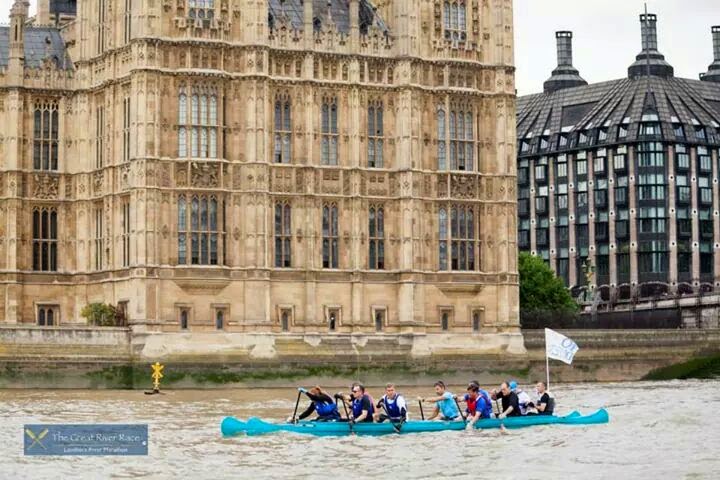
I thought I would put my strength to test for charity and a few weeks ago I rowed London's Great River Race - 21.7 miles (about 32km) along the river Thames. It was great fun, but also proved to me that shoe making at the workbench gives the best core and upper body workout! I felt great and had zero aches and pains.

Lawrence, me, Thomas, Joel, Ian, Klaus, Nick, Rob, Victor and Svend (taking the pic).
a great mix of nationalities British, Danish, Swedish, German, half American, half Indian, half Thai & Russian
We did it in 3 hours 5 minutes, missing the fastest time for our veteran class by just 15 minutes and only hitting one boat even though we had done no training and only five of us had ever actually been in the boat together before.

Passing the Houses of Parliament - yes that's me at the front!
Success!

We're going for the fastest time next year, so I'll be training hard at my making bench. Until next week happy shoemaking!

Friday, October 3, 2014

A Celebration

Welcome back once more, dear readers, to your window onto our world. A world of craftsmanship, creativity, passion and hard work. With a simple target - handsome shoes for satisfied customers. Sounds simple anyway, and in some ways, it is. A clear goal to work to, but, in our ten years in business, we have learned that the goal is not a static point at which you arrive, but rather movable point forever in front of you which edges ahead in direct relation to what you achieve in your business. This is an ever evolving landscape and we relish the challenge.

You might wonder about the expansive opening to this week's post. Well, while conducting a regular review of the blog statistics, we noticed that the hit counter has reached half a million page views which, to our eyes, is a significant achievement.

Apart from being astounded by the success of the blog, we are also humbled and delighted. We must thank all of you who read it; learn from it; make shoes from it; comment on it; and promote it. All of you around the world, from Eritrea to Japan, Finland to Argentina. This really is a global community of people who care about handsewn shoemaking.

Happily, over the past several years, we have noticed a huge groundswell of interest in our craft and we like to think that this blog plays a small part in that movement. From those of you who aspire to become shoemakers to those who simply enjoy reading about our shoemaking techniques, we are proud to have given our knowledge freely.

Of course, we benefit from writing it - our courses have become very popular (book early to avoid disappointment!) and the interest in the craft we generate eventually filters down to customers and new orders. But our prime motivation is promoting handsewn shoemaking and sharing our skills with those who seek this knowledge.
Just last night at an event called Best of Brittania, I met two owners of new British shoe brands who recognised me and said they read the blog regularly and had learned from it. This makes us really proud.

So, in a spirit of celebration, there follows a personal selection of Carréducker's"greatest hits".

In at number ten is this classic black wholecut  shoe with red kid lining, made in 2006. Love the toe shape and the timeless elegance.


Number nine is our electric blue suede Chelsea boots made in 2010 - enough said.


Number eight is the Special, the Carréducker Extreme Brogue boot with added tweed, made in 2008 - love it!


Number seven. Our pared down tan loafer, transformed by an expert French patina artist, 2009


Riding high at six is our Mayfair Derby, chisel toe and wingcap, 2012. I love Derby shoes


Number five is mostly here because of the colours - grey suede and light blue kid, 2011


Number four is a ladies' shoe, the Dietrich. Love the retro vibe and the purple piping, 2009


Number three is a recent gem, again a Derby and a great colour combination. And they are mine to wear and to love! 2014


Number two is the original version of the previous entry - never bettered in my mind. 2009


And so to number one, an old favourite, the Saddle Boot, this one in blac and antiqued tan box calf. We have made a lot of these over the years and it was one of the first boots we made, 2004.


And that, as they say is a wrap. Once again, a special thanks to you, the readers. Here's to another half a million hits!

Until next week, happy shoemaking!


Friday, July 25, 2014

Breaking Glass

Broken glass is usually a bad thing, but when it comes to shoe making a well broken piece of glass can be the making of a smooth sole edge, sole or heel. It is a vital part of finishing. 

Whilst rasping the edges blends the layers of leather together to make one surface, glassing then smooths that surface, before sanding with the differing grades of sandpaper.


Picture frame glass is ideal - not too thick and not too thin - and we keep a ready supply in a sturdy box in the studio. The ideal thickness of glass is 2-3mm because it breaks cleanly. Any thinner and you're likely to get more shards and any thicker and breaking it is more difficult with less clean results. 


Use another piece of glass or a file to nick or chip the edge of the glass (make a small dent in the edge).


Rest the edge of glass with the dent in it on a sharp edge such as the edge of your work table or burner. Position the nick so that it is right on the sharp edge. Lean the glass forward at about 45 degrees.


Press gently forward and down with your thumbs, slightly rotating your wrists outwards. 


This should take very little effort. Do not force it. If it does not break first time, then adjust the angle of the glass slightly or nick it again. The gentle pressure from your thumbs should break the glass into two pieces, one with a convex edge and with with a concave edge.


Concave and convex lenses


It is the outwardly curved convex edge that we use to scrape edges and soles.


And in case any of you are wondering how the hammered boots from the last two posts turned out....here they are finished!


 Until next week, happy shoe making!