Showing posts with label construction methods. Show all posts

Friday, November 7, 2014

Below 10 degrees? It must be Boot Time!

The weather in England has finally noticed that it is November. After the warmest Halloween night on record, the temperature finally dropped so that our traditional 5th of November, Bonfire Night could be spent in scarves, gloves and hats.

(In brief, Halloween or All Hallows Eve revolves around the theme of using humour and ridicule to confront the power of death, whilst  Bonfire Night celebrates Guy Fawkes failure to blow up the House of Lords and King James 1 in 1605).

Anyway, enough of history, colder weather means boots, so here are a few recent commissions!

Stalking boots in green, oiled Nubuck with a bellows tongue, leather sole and ridged rubber heels/sticker sole


and in the same style in Horween Latigo with golf studs, rubber soles and cleats for extra grip on the hillsides. 


Tall, plantation boots with straps to close off the boot upper to keep the creepy-crawlies out!


A pair of ladies' knee boots with an elegant toe and front seam.


Soul-full, suede desert boots with beautiful scarlet linings.


And finally, THE riding boots...


We'll be kicking up the autumn leaves and cosying up to a roaring fire this weekend. Until next week happy shoe making!

Friday, October 31, 2014

Shape matters!

When we're teaching, students often ask how important the last is to the look of the finished shoe. Well the last and toe shape are a vital starting point, but in fact every decision that you make actually impacts on the final look of a shoe.

James and I have been discussing which last we should choose for our new spectator design and we thought that this would be a good way of illustrating this point. Below are the two lasts we are thinking about.  The upper has been made from a pattern for one of the lasts, but we've pulled it over both to see how it looks. Very different as you can see!


We originally used the last on the left for our new Loafer and the last on the right for our new Oxford (see below).

You can see how different from the Spectator the Loafer and Oxford look, despite the lasts being the same. The lack of seams on the Loafer and the skin texture of the Crocodile give the shoes a completely different feel to the Spectator example.


The Loafer last looks more casual and relaxed with its flat, rounded toe. and the Oxford last looks more elegant and sleek with its elongated, snub nosed toe.


But how different will they look if the sole is leather, or rubber or crepe?


Can you picture it? And can you guess what we chose?

Food for thought. Until next week happy shoemaking!

Friday, October 10, 2014

Strength of a shoemaker


We're delighted to say that the work at No.1 Savile Row is finally finished, the store is fully open and looking resplendent. 


It is masculine, warm and very welcoming with flagstones, glass and oak displays and strong, graphite walls...the perfect complement to Gieves' autumn Highland collection.

Inspired by our new surroundings, we've developed a capsule collection of new bespoke samples starting with a simple Wholecut in Chestnut calf, an Oxford in French Navy crocodile and a Loafer in tobacco suede with lizard skin 'lantern' tassels. A spectator in slate blue canvas and chestnut calf will be added soon.


Perhaps most exciting for us has been discovering our own signature toe shape - seen above in the Oxford shoe. It is taken from an original '30s last and has a distinct 'snub' nose. Look out for more shoes with this toe shape from us in the future.

With our autumn course entering the 'welting phase' there have been mutterings of machines and more than a few questions about just how strong you need to be a shoemaker. Is it a case of physical strength or tool technique?

The shoemaker's 'butterfly'

In truth it is a mixture of both. Historically boys and young men made shoes in small workshops in almost every town, proving size isn't everything! Today's hand sewn shoemakers, men and women, come in all shapes and sizes and, an enterprising bunch, they continue to find their own way around the centuries-old techniques from....

- standing up to work at a bench
- using a strap to hold their work in their laps
- welting and stitching using cut-off gardening or cycling gloves
- sanding and finishing using machines (yes, I said it, machines)

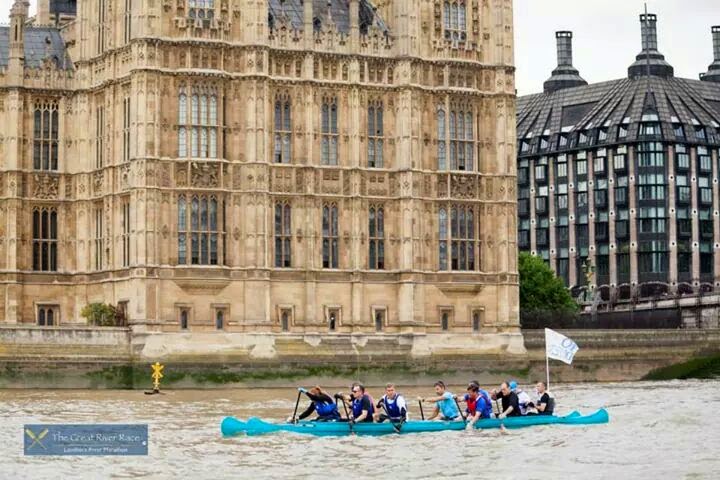
I thought I would put my strength to test for charity and a few weeks ago I rowed London's Great River Race - 21.7 miles (about 32km) along the river Thames. It was great fun, but also proved to me that shoe making at the workbench gives the best core and upper body workout! I felt great and had zero aches and pains.

Lawrence, me, Thomas, Joel, Ian, Klaus, Nick, Rob, Victor and Svend (taking the pic).
a great mix of nationalities British, Danish, Swedish, German, half American, half Indian, half Thai & Russian
We did it in 3 hours 5 minutes, missing the fastest time for our veteran class by just 15 minutes and only hitting one boat even though we had done no training and only five of us had ever actually been in the boat together before.

Passing the Houses of Parliament - yes that's me at the front!
Success!

We're going for the fastest time next year, so I'll be training hard at my making bench. Until next week happy shoemaking!

Thursday, September 18, 2014

An Experiment

Welcome back once more, dear readers, to the wonderful world of bespoke shoes. Aren't we lucky to have found such an absorbing trade? We hope you have had a productive week and have had your hands on some oak bark pit tanned cow hide - a treat for anyone, if only they knew!

We have been working to prepare a travelling exhibition which will feature two of our shoes and some assorted tools, leathers and sundry shoemaking  paraphanalia. It is run by Fife Contemporary Art and Craft and will be touring public libraries in Scotland over the next year. Our shoes will be housed in two Craft Pods along with a description of our craft and something about Carréducker. Looking forward to seeing some pictures of the launch which happens on the 23rd of September.

Onwards and upwards. While making a pair of bottle green oiled nubuck stalking boots (as you do), I had a bit of an idea. This does happen occasionally and I wanted to try it out. BTW Horween make the oiled nubuck and it's really luscious, waxy and alive - check it out

I wanted to insert a midsole made of a thin piece of Topy (brand name) sticker sole - a synthetic sheet 2mm thick. This would create a thin black line between the natural welt and natural sole and would look quite stylish

And here's the problem. Our understanding was always that you can't hand stitch these synthetic materials by hand because when you pull the awl out of the hole, the hole closes up - unlike the leather where the awl actually leaves a hole because the leather compresses when the awl goes in.

When a customer asks for a synthetic sole (Dainite, commando, Ridgeway or such) from us (it does occasionally happen), we last and welt the shoes as normal, except that we welt round the seat as well.

See this blog post for details of how we do it.

At this point we send the shoes to a company which stitches on the desired sole with a sole stitching machine.

Now I had never tried out the theory explained above and being a doubting kind of person, I wanted to test it.

So, here's what happened

The synthetic sandwich was made


And the awl was put through.

The bristle was then inserted and as suspected, it didn't come out the other side. The theory was proved correct. To be honest, I did push the awl through so far and wiggled it that I was able to put one bristle through, but the second was impossible.


The next step is to find a way of doing it. The only thing we can think of is to make a hollow awl which actually punches a whole in the synthetic material, much like what they use for body piercing. Something which takes out a little piece of the rubber.

Sounds like a project. Any tool makers out there?

Or, dear readers, is there another way? Do you know how to do it and make an old shoemaker happy? Let us know and we will be forever grateful.

Till next week (in hope and anticipation), happy shoemaking!

Friday, August 29, 2014

Bakers of Colyton 1

Back from a lovely week in Sark and with Mr Ducker relaxing in the Peak District we wanted to share our recent trip to Baker's of Colyton...a trip that has been far too long in the offing. 

Anyway, we finally made it by train and then local bus to Colyton for some Devon sunshine, hospitality and surroundings that even my camera phone makes look idyllic.

The buildings may vary in age but Farrow and Ball would have a field day with the textures, colours and hues. The atmosphere is one of quiet, steady work with good natured chaps going about their daily work with the minimum of fuss in bucolic surroundings; creating the finest leathers in an entirely sustainable way. 

This site has been a tannery since Roman times and has been in the Baker family since 1862. The only oak bark tannery remaining in Britain, Bakers' tanning methods have been perfected over the centuries to create leather that is unrivalled - hard wearing, strong and with distinctive colours - that we use throughout our bespoke shoe construction and for students on our courses.

James arriving at Bakers

The original  thatched building at the entrance to the Bakers' site housed the original currier - responsible for dressing the tanned hides
A painterly palette

An scythe, hoe, spade and sickle keep nature at bay
Where the waste water from the tannery runs away; no chemicals or pollution
Looking down on the oak bark store


Dressed hides in beautiful mocha, caramel, sable and honey
Rows and rows of nails in the beams - a story of past activities


Even the floor vents are beautifully designed


The brass roller
Andrew Parr sharing his knowledge with James
Unsorted, stacked bends


Ropes from the tanning pits, preserved and strengthened with the tanning process
More from Bakers next week. Until then happy shoemaking!