Showing posts with label leather. Show all posts

Friday, November 7, 2014

Below 10 degrees? It must be Boot Time!

The weather in England has finally noticed that it is November. After the warmest Halloween night on record, the temperature finally dropped so that our traditional 5th of November, Bonfire Night could be spent in scarves, gloves and hats.

(In brief, Halloween or All Hallows Eve revolves around the theme of using humour and ridicule to confront the power of death, whilst  Bonfire Night celebrates Guy Fawkes failure to blow up the House of Lords and King James 1 in 1605).

Anyway, enough of history, colder weather means boots, so here are a few recent commissions!

Stalking boots in green, oiled Nubuck with a bellows tongue, leather sole and ridged rubber heels/sticker sole


and in the same style in Horween Latigo with golf studs, rubber soles and cleats for extra grip on the hillsides. 


Tall, plantation boots with straps to close off the boot upper to keep the creepy-crawlies out!


A pair of ladies' knee boots with an elegant toe and front seam.


Soul-full, suede desert boots with beautiful scarlet linings.


And finally, THE riding boots...


We'll be kicking up the autumn leaves and cosying up to a roaring fire this weekend. Until next week happy shoe making!

Friday, September 26, 2014

A Good Break


This week has been a busy one of fittings and adjustments for a client with enlarged big toe joints and a nerve problem in his right foot, but not his left. This means that both lasts have prominent fittings to accommodate the joints and the right shoe needs to be wider than the left at the vamp to ensure that the toes are not cramped.

Naturally the shoes still need to look like a pair, so we have used felt to pad out the left shoe, between the lining and the upper, so that they look similar. 


It has also been an exercise in fine tuning the fit, to create the room needed at the toes and at the big toe joint, without inadvertently creating bad break. Break - where leather folds and creases against itself - is a vital consideration in footwear where the vamp folds and creases as you walk.


Bad break is where there is too much leather in the vamp, creating deep creases which dig into the foot when it flexes or where the shoe is not the right length for the foot; too short and the vamp will break too far forward, too long a shoe and the vamp will break too close to the quarters and laces. Good break is tight, shallow creasing across the vamp behind the toes.

To make good break on this client's shoes, we lowered the fore part of the last diagonally from the big toe joint across to the outside feather and at the toes. We also soaked the uppers and lasted them mellow, so that they shrunk down onto the lasts. The result, tight creases and a good looking and accommodating fit.   


Obviously well fitting shoe trees are also an important part of the picture. They help to smooth out the creases in the vamp when the shoes are not being worn and prevent dirt and moisture from building up in the creases.


There is a great post on the Horween blog if you would like to find out more about leather properties and 'break'. Until next week happy shoe making!

Friday, September 5, 2014

Bakers of Colyton - Part 2

This is the second part of  our photo diary from J & FJ Baker of Colyton. This time we will take you through the various aspects of the tanning process from the oak bark to the hides arriving to the dressing and sorting.


Traditionally all leather in England was oak bark tanned because of the ready supply of oak, with a tannery in every village and a ready supply of local cattle. In France and Italy it was chestnut bark tanning because that was the local wood.


The tour of Baker's with Andrew Parr begins.


The oak bark is stripped from trees in the spring from woodland in the South West. It is stored for three years until completely dried out and is then ground down to be used in the tanning pits.

Ground oak bark


The oak bark liquor ready to be used in the tanning pits
The tan is soaked out of the bark using natural water, a bit like making tea.


Oak bark liquor pits
When the tan is strong enough it is pumped up to the tanning pits. 

Today, Baker's hides are still locally sourced from the South West of England, in particular Devon.

Stacked, salted hides

The hides are first salted to preserve them and then de-haired in lime pits. Soaking in the lime loosens the hair and removes fatty deposits from the underside of the hides. 


Walking up to the raised lime pits
 
The lime process with 60 skins in each pit.
 
The lime pits remove the hair and fatty deposits from the surface
leaving it smooth and clean
Once de-haired the hides are called pelts. The pelts then go from the lime pits to the beam house - where any remaining hair is removed and the lime is washed out from the pelts, so that the surfaces are clean - and finally to the tan yard.

Washing down the tanned hides
There are 72 pits in the tannery with the strength of liquid increasing in strength from  the bottom to the top. 

The tanning pits with oak bark liquor of different strengths.

New pelts are put into the weakest tanning liquid and each week are moved on to the next strongest pit. They are hung on wooden sticks so that they tan evenly all of the way around. 

After three months they are taken off the sticks and are laid flat in pits with oak bark chippings in between each layer.  They are kept in the pits for a further nine months, so the entire tanning process takes 12 months.


The pelts are then taken out of the pits and drained for a couple of days, before going through to the finishing room. They are now leather.

The finished bends sorted by thickness and stacked ready to go out
Oak bark tanning is a slow process, but the benefits are its tensile strength, durability and the fact that it is lightweight. It is used primarily in leather goods, saddlery and, of course, high end footwear.


Once the tanning is completed the leather is finished and dressed depending on its final use. The welt leather is dressed to improve its waterproofing and saddlery leathers are dyed and dressed to add colour and waterproofing.  
An old but very much used roller - wide enough to take large bends
Finally the bends and bellies are rolled before being stacked by thickness ready for the orders to come in.

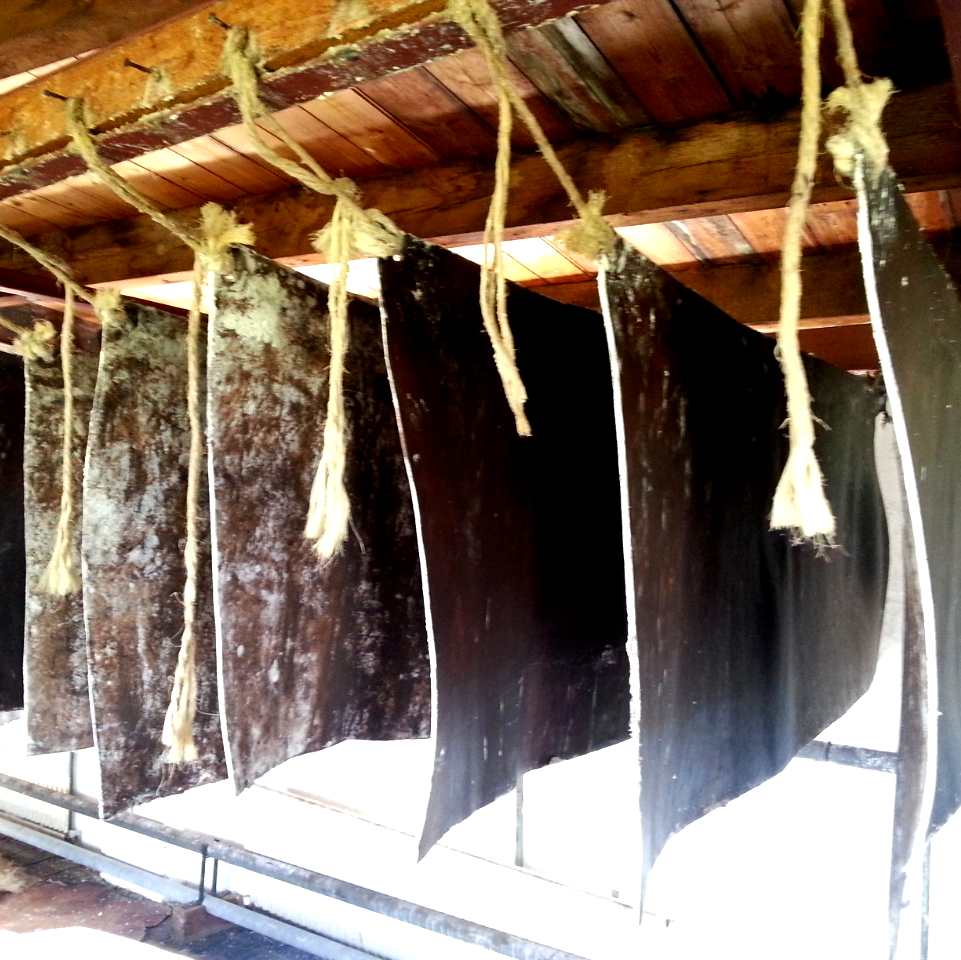
The tanning pit ropes strengthened and preserved through the tanning process
That's the tanning process in a nutshell, but take a look at Baker's own film below for the full story.


Until next week happy shoe making!

Friday, August 29, 2014

Bakers of Colyton 1

Back from a lovely week in Sark and with Mr Ducker relaxing in the Peak District we wanted to share our recent trip to Baker's of Colyton...a trip that has been far too long in the offing. 

Anyway, we finally made it by train and then local bus to Colyton for some Devon sunshine, hospitality and surroundings that even my camera phone makes look idyllic.

The buildings may vary in age but Farrow and Ball would have a field day with the textures, colours and hues. The atmosphere is one of quiet, steady work with good natured chaps going about their daily work with the minimum of fuss in bucolic surroundings; creating the finest leathers in an entirely sustainable way. 

This site has been a tannery since Roman times and has been in the Baker family since 1862. The only oak bark tannery remaining in Britain, Bakers' tanning methods have been perfected over the centuries to create leather that is unrivalled - hard wearing, strong and with distinctive colours - that we use throughout our bespoke shoe construction and for students on our courses.

James arriving at Bakers

The original  thatched building at the entrance to the Bakers' site housed the original currier - responsible for dressing the tanned hides
A painterly palette

An scythe, hoe, spade and sickle keep nature at bay
Where the waste water from the tannery runs away; no chemicals or pollution
Looking down on the oak bark store


Dressed hides in beautiful mocha, caramel, sable and honey
Rows and rows of nails in the beams - a story of past activities


Even the floor vents are beautifully designed


The brass roller
Andrew Parr sharing his knowledge with James
Unsorted, stacked bends


Ropes from the tanning pits, preserved and strengthened with the tanning process
More from Bakers next week. Until then happy shoemaking!